GARRICK TAYLOR BYRNE
CUSTOMER DIFFERENTIATION
introduction
Houston BCycle is a bicycle rental service serving central Houston, Texas, United States. As of this writing, bicycles can be rented at one of 140 kiosks. After use, bicycles must be returned to a kiosk. Houston Bcycle is not free to use; Bcycle offers various rental plans, from pay-as-you-go options to monthly and yearly subscriptions.
Austin, Texas has a similar program branded Austin Metrobike. During the timespan included in Metrobike’s publicly available data, Metrobike operated 98 kiosks, of which 91 were active as of the data creation date. Like Houston Bcycle, Austin Metrobike offers a variety of rental plans with various time commitments.
The goal of this project was to ascertain how usage habits varied between short-term pass buyers and long-term subscribers.
remarks about data sources
Austin makes data about Metrobike available on the city’s data-sharing web site. During the timeframe I was working on this project, the publicly available dataset consisted of 1,424,786 rows, each row corresponding to one bicycle check-out-to-return cycle. The data spanned the period from December 21, 2013 to July 31, 2021.
Houston Bcycle does not make its data available on the web, nevertheless, I was able to get in contact with a staff member from Houston Bcycle who provided me with data covering January through August 2021. The Houston Bcycle data set contained 198,126 rows, each row corresponding to one rental event.
methodology
Rather than compare usage across all the months that the datasets have in common, I decided to focus on April, 2021. By focusing on a single month, I endeavored to minimize seasonal variation, e.g. climactic variation and school semesters starting or ending. In April the climate is amenable to bicycle riding, and schools are in session for the entire month. Both datasets contained data for April 2021.
For both services, I sorted the user base into two groups based on the user’s rental arrangement at checkout time. Each rental trip record in both datasets included the membership type used for the rental. I studied each service’s membership types, then classified the membership as either a long-term subscription or short-term pass. For example, I classified Houston Bcycle’s “guest” option in which users are billed in 30-minute increments as a short-term pass and monthly and yearly memberships as subscriptions. Based on the membership type, I coded the rental event as being undertaken by a long-term subscriber or a short-term pass holder.
findings
The usage patterns of Houston Bcycle’s users varied substantially between the subscribers and the short-term pass holders. I used heatmaps to show how many trips commenced during each hour of the week. By juxtaposing the checkout times of each group of users, I hoped to glean some clues about how needs and habits vary between the groups.

Houston Bcycle subscribers use the service most heavily on weekday mornings and afternoons. Short-term pass holders use the bikes mostly on weekends.
We see that long-term subscribers rent bikes most often on weekday mornings and afternoons, whereas short-term renters use the service mostly on weekends. We also observe that, for the subscribers, the period of heaviest afternoon usage gradually shifts earlier from Monday through Thursday, and Friday afternoon use appears to be similar in magnitude to light weekend usage.
I hypothesize that the subscribers are using the service to commute to and from work or school whereas the short-term pass holders are taking leisure trips. To test this hypothesis, let’s examine the data in a spatial context.

On weekday mornings, we see very heavy usage by people commuting to the Medical Center from residential areas surrounding the Medical Center. We also see students from the University of Houston’s Cougar Place residential facility travelling to UH’s research center on the Gulf Freeway. There is also significant one-way traffic downtown along Milam. The impetus for this downtown activity is a question for further research.
When considered in the context of then-current events, these traffic patterns make sense. During the coronavirus pandemic, there was a great demand for medical treatment, and most clinical work cannot be done via telecommuting. On the other hand, jobs based in downtown offices could be more easily migrated to remote work, which is why we see only light inbound travel to downtown destinations.

To explore further the idea that subscribers rent bikes for commuting, let’s examine the subscribers’ afternoon travel.
Afternoon activity further supports my hypothesis that subscribers use the bikes for commuting. As we would expect, we see the medical workers returning home and UH students returning to the school’s residential facilities.

We’ve learned that Houston Bcycle long-term subscribers use the service primarily for commuting and the short-term pass holders are recreational riders.
Now, let’s compare the activity of Houston Bcycle’s users with that of Austin Metrobike’s users.
Like Houston’s short-term pass riders, Austin’s short-term pass users appear to use the bikes for weekend afternoon leisure rides. Austin’s long-term subscribers, however, have very different usage patterns than Houston’s long-term subscribers. Austin’s subscribers use the service heavily on weekends whereas Houston’s long-term subscribers do not. With Houston’s subscribers we see a distinct usage spike corresponding to morning commuting, but this activity is absent in Austin’s data. We do see a pickup in subscriber usage during the afternoon commuting period. To understand Austin’s subscribers better, let’s plot their weekday afternoon movements on a map.
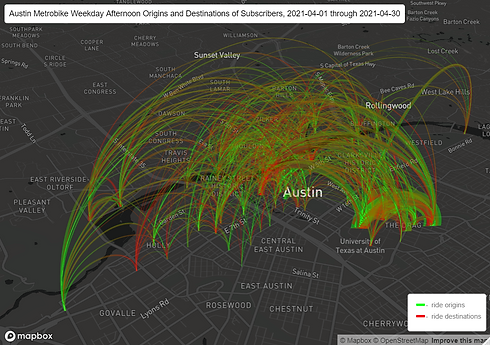
A map of Austin Metrobike’s subscribers’ weekday afternoon trips reveals little about their intended usage of the service. No clear generalizations about origins and destinations can be observed, except that there appears to be substantial bidirectional travel between the UT-Austin campus and surrounding areas.
Thinking that the coronavirus pandemic was responsible for the absence of a clear commuting pattern among Metrobike’s subscribers, I decided to look further back in the dataset to pre-coronavirus times to see if I could detect the characteristic morning and afternoon commuting spikes.
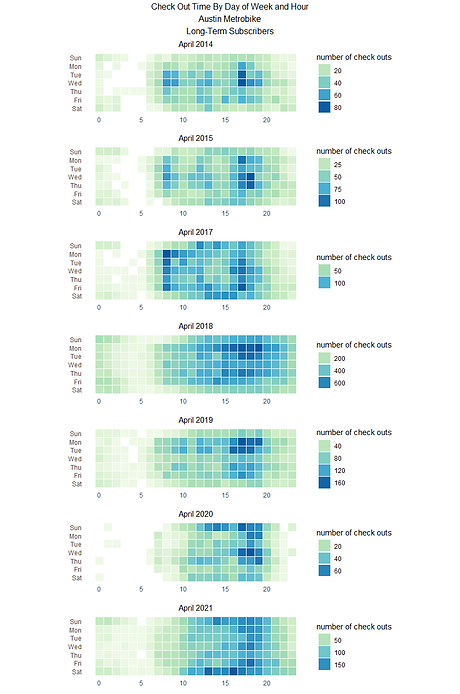
I prepared a heatmap visualization for April of each of the years covered by the dataset. We see a nascent commuting pattern in the 2014 data, with the commuting usage most easily detectable in the 2017 data. The commuting use pattern dissipated quickly after 2017. Perhaps the bike share service fell out of favor among commuters, or the demographic who used to rent bikes for commuting transitioned to flexible work arrangements well before the coronavirus pandemic. This is a subject for additional inquiry.
The dataset lacked data for April 2016, and the dataset indicated a substantial increase in use during April 2018. As far as I could tell, there was no duplicate data for 2018.
Thus far we have examined the activity of the bike sharing service subscribers. Let us now turn our attention to the short-term pass buyers. When I was perusing the August 2021 Houston data, I was surprised to see that short-term users checking out bikes on weekday evenings at rates comparable to weekend usage. I hypothesized that the leisure riders were adapting their exercise routine to Houston’s climate. When we look at the short-term pass users’ activity from January through August, we see the short-term users went for weekend afternoon jaunts while the weather was temperate, and gradually moving their outdoor activity to evenings as the weather became hotter.
This led me to wonder whether Austin’s leisure riders were similarly sensitive to the heat. Apparently, Austinites are less sensitive to the heat than Houstonians. The short-term pass holders’ typical weekend afternoon use remained consistent from January to July 2021. Note that the Austin dataset ended on July 31, 2021 whereas the Houston data ended on August 31, 2021.


Just out of curiosity, I mapped the origins and destinations of Houston Bcycle’s short-term users. The map on the left shows short-term passholders’ traffic on weekends in April. The map on the right shows short-term passholders’ activity on both weekdays and weekends in August. In both April and August, we see that leisure riders like to ride bidirectionally the trails along Buffalo Bayou and White Oak Bayou. By far the most popular origin / destination combination is the short ride between Eleanor Tinsley Park and the Lee & Joe Jamail Skatepark.


conclusions
The intention of this project was to determine whether bike rental usage differs according to the membership plan of the renter. We see that it does. Users of short-term arrangements tend to be recreational riders who use the rental bikes on weekend afternoons, or, in the case of Houston riders, other leisure times, depending on climate. Houston users who choose longer-term subscription plans tend to use the bikes for commuting to and from work. The habits of Austin’s long-term subscribers are less clear. The last time a clear morning and afternoon commuting pattern was seen in the Austin data was 2017.